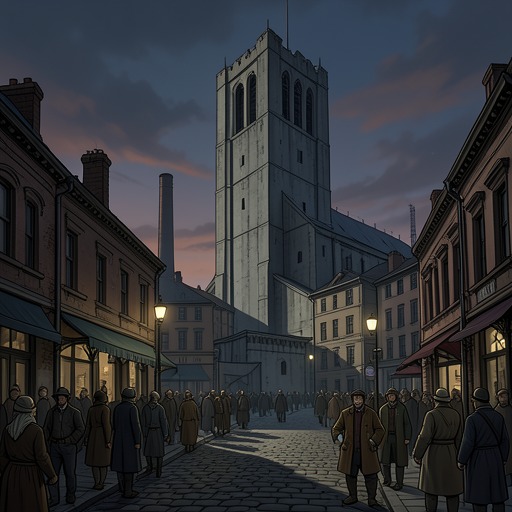
Intergenerational trauma in the Von Riesen family
All My Puny SorrowsIntergenerational trauma in the Von Riesen family is not presented as a single past wound but as a history that keeps shaping language, religious life, family choices, and later grief. The family’s Mennonite ancestors carried memories of violence and migration from Siberia to Canada; their descendants inherited both the pain and the habits of silence surrounding it. The novel also asks what inheritance can explain, and what it cannot excuse, as Yolandi Von Riesen confronts the damage done within her family and community.
Historical Violence and Migration
The family’s ancestral history reaches back to a small Mennonite village in Siberia in 1917, the year of the Bolshevik Revolution. The account identifies this place and period as the source of terrible experiences, and describes how even a passing reference to Russia could unsettle Yolandi’s parents. The past persists not as a complete, openly told history, but as a subject charged with fear and distress.
One especially stark family story concerns Yolandi’s paternal grandfather. His parents were killed near their home, while he survived by hiding in a pile of manure. He was later transported with thousands of other Mennonites to Moscow and sent on to Canada. The sequence joins private loss to forced displacement: survival did not end the trauma, but carried the survivor into a new country and into the family life of later generations. His green eyes and the persistent scenes of violence associated with them make memory appear present even in moments when he smiled.
The novel gives another, more limited account of loss in a conversation between Yolandi and Julie. Yolandi asks whether Julie still suffers because her grandparents were massacred in Russia. Julie corrects the family detail: it was her grandmother, who was nine months pregnant and unable to run, while her grandfather escaped with the other children. When Yolandi asks whether such events can still affect people in the present, Julie does not offer a clear explanation. Her shrug leaves the question open rather than resolving inherited trauma into a simple diagnosis.
Silence, Language, and Religious Authority
Plautdietsch is described as a language of shame, bound to the Mennonite history of enduring pain without speaking about it. Yolandi’s grandfather warned her parents not to teach it to their children if they wanted them to survive. That advice turns language into a survival question: the language carries family belonging, but also recalls a history that the older generation fears will endanger the young. Silence, in this account, is both a response to suffering and one of the means by which its history is passed on.
Religious authority supplies another setting in which inherited fear and present-day control meet. When the bishop and a group of elders visit the family home, their stated concern is that fifteen-year-old Elfrieda plans to attend university to study music. The elders distrust higher education, particularly for girls, and one warns that she will acquire ideas. The scene shows the family’s private decisions being judged by a community authority whose influence reaches into education and women’s futures.
The community’s restrictions also shape the place of music in the family. Pianos are prohibited in East Village, but Yolandi’s parents secretly bring one into the house after a doctor recommends a creative outlet for Elfrieda. They cover it when elders visit. After the elders discover it, they discuss possible punishment for Jake, but relent on the condition that the parents ensure the instrument is used only for religious purposes. Against this background, Elfrieda’s playing for the assembled elders becomes more than a display of skill: the music makes audible a desire for a life that the community’s rules cannot comfortably contain.
Inheritance Within the Family
The pressure surrounding Elfrieda’s education and music does not establish that the family’s historical trauma directly causes every later conflict. Rather, the novel places inherited silence beside the family’s present encounters with religious discipline and emotional distress. Yolandi’s mother later studies to become a therapist and learns that suffering can pass from one generation to another. The idea gives the family a language for understanding transmission, while the narrative’s particular histories show how that transmission may occur through warnings, silence, fear, and expectations placed on children.
The extended family’s grief also appears through repeated losses. One evening, Yolandi puts her mother and aunt to bed with their crime novels and reflects that the two sisters are the last surviving members of a family of sixteen children. They have buried siblings, daughters, husbands, and parents. The aunt’s Plautdietsch bedtime blessing recalls words once spoken to Yolandi and Leni when they were young; the memory is inseparable from Leni’s later suicide in the Fraser River. The intimate use of the old language therefore carries tenderness as well as the family’s accumulated bereavement.
Yolandi’s Reckoning with the Past
In a later moment of anger, Yolandi reflects on the terror and condemnation imposed by Mennonite men in church. She remembers herself, Elfrieda, her father, and her cousin as innocent children, and connects the adults’ conduct to the history of their family being slaughtered in Russia and forced to flee. Her reflection recognizes the force of ancestral suffering, but it also resists using that suffering to absolve those who make others feel small or condemn them as evil. The past may help explain the transmission of fear and cruelty; it does not erase the consequences for the next generation.
This reckoning unfolds while Yolandi is returning to the hospital after an outburst connected to the family’s immediate crisis. She considers whether a heart attack might be connected to the pain of remembering, then weighs that possibility against physical explanations such as heart disease, smoking, and diet. She does not settle the question, and her speculation is not presented as a medical conclusion. Its importance lies in the unresolved connection she perceives between bodily crisis and remembered suffering, and in her wish that psychiatry and cardiology could address such experiences together.
Meaning and Limits of Inheritance
The novel’s treatment of inherited trauma moves between historical narrative, family recollection, and Yolandi’s present-day questioning. It gives concrete form to transmission through the grandfather’s migration, the warning against Plautdietsch, the elders’ regulation of Elfrieda’s education and piano, and the recurring losses remembered by the surviving sisters. These are distinct experiences, not interchangeable symptoms, yet together they show how a family’s history can continue to organize what its members fear, remember, and permit.
At the same time, the narrative preserves uncertainty. Julie’s response does not confirm that descendants must experience their ancestors’ trauma in a particular way, and Yolandi’s reflections do not establish a single cause for later illness or conflict. Inherited suffering remains a powerful context rather than a total explanation. The distinction matters: the family history clarifies the weight carried across generations, while Yolandi’s judgment insists that the effects of that history on other people still demand recognition and accountability.